New York’s Molly Tea stores lost the logo and became “? Tea”
New York’s Molly Tea stores did not just change their name.
New York’s Molly Tea stores did not just change their name. They became one of the most visible examples of the messy middle stage of Chinese consumer brands going global: fast growth, local partners, licensing agreements, trademark control, and then a legal fight over who gets to keep operating under the brand.
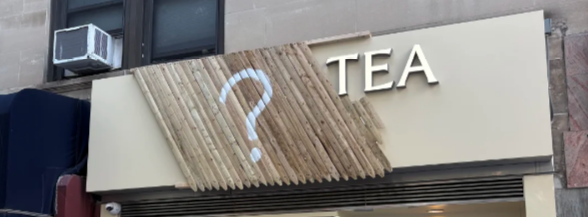
In June 2026, several Molly Tea stores in New York suddenly covered their original branding with a bold black question mark. Store signs, cups, menus and other materials were changed from Molly Tea to “? Tea,” while some locations continued operating. The rebrand followed a dispute between Molly Tea’s China-based brand owner and its US operating partner. On June 8, the Southern District of New York issued a preliminary injunction restricting the relevant stores from using Molly Tea trademarks, branding, online accounts and delivery-platform listings while the litigation continues. This was not a final ruling on the underlying dispute.
Molly Tea, known in China as 茉莉奶白, is a Shenzhen-born new tea brand founded in 2021. Unlike cheaper mass-market bubble tea chains, Molly Tea built its identity around floral Chinese tea bases such as jasmine, white orchid and gardenia, with soft, polished packaging and a more premium visual style. According to local Chinese business reports, the brand has grown to more than 2,300 stores in China.
Its US expansion began as a strong success story. In December 2023, Molly Tea signed a cooperation agreement with its New York partner MHL NY LLC, authorizing the partner to develop up to five stores in New York. The basic division was simple: the brand side provided brand authorization, technical support, operations guidance and supply-chain support, while the US partner handled much of the local execution, including site selection, leases, store buildout, local operations and marketing.
In April 2024, Molly Tea opened its first overseas store in Flushing, Queens. The store quickly became a benchmark for Chinese tea brands in North America. Chinese media reported that the Flushing location reached monthly GMV close to USD 500,000, with daily cup sales stabilizing at around 2,000 cups. That made it more than a normal franchise opening. It became proof that a China-born new tea brand could attract serious demand in a competitive US city.
After Flushing, the US partner expanded to Brooklyn and Manhattan Chinatown. In July 2025, according to reporting by 36Kr and other Chinese outlets, the two sides signed additional limited liability company agreements for three stores and formed joint ventures. The reported ownership structure gave the US partner 80.1% and the brand side 19.9%.
The relationship began to crack in early 2026. According to reporting based on case materials and interviews, Molly Tea later presented new shareholder agreements and sought to raise its ownership share in the existing stores. Around the same period, the brand side also sent the US partner Franchise Disclosure Documents, or FDDs. In the US, an FDD is a key legal document used in franchise relationships. The timing became one of the major points of dispute because the US stores had already been operating for a long period before those documents were formally introduced.
The disagreement intensified around new store development. In March 2026, the two sides discussed a store near Columbia University. Reports say the brand side proposed a different ownership structure for the new store, with Molly Tea taking a much larger share than in the earlier New York locations. The US partner rejected the new terms and also declined to sign the FDD documents, arguing that some provisions were unfavorable, including concerns over a short franchise term and lack of territorial protection.
By late March and early April, the conflict moved from negotiation to operational disruption. According to 36Kr, on March 31, Molly Tea’s overseas director allegedly told the partner that if the FDD was not signed, all stores would be suspended. On April 2, the brand side notified several US locations, including New York and Los Angeles stores, of an indefinite suspension for rectification. The US partner later alleged that support around supply chain, logistics, delivery platforms, email access and POS systems was cut or restricted.
On April 16, MHL NY LLC sued Molly Tea’s headquarters and related parties in Queens County Supreme Court, asking the court to stop the brand side from interfering with store operations and to restore operational support. The next day, the state court issued a temporary restraining order. Also on April 17, the Columbia University-area store opened without a finalized joint-venture agreement, which Molly Tea’s side later pointed to as an example of unauthorized expansion.
On May 1, Molly Tea’s side sent a letter terminating the US partner’s authorization to use the Molly Tea brand. On May 15, Shenzhen Molly Tea Food and Beverage Management and related entities filed a trademark case in the Southern District of New York against MHL NY LLC and related companies and individuals. The case was filed as a trademark matter under the Lanham Act, and court docket records list defendants including MHL NY LLC, Molly Tea CU LLC, Genesis Brand Management LLC, Molly Tea NYC Inc., Molly Tea BK Inc. and Molly Tea Manhattan Chinatown Inc.
Molly Tea’s side has accused the US partner of unauthorized expansion, continued use of the brand after termination, breach of agreements, and operating outside the brand’s control system. One major allegation concerns the Columbia University-area store, which Molly Tea says was signed through a separate company without headquarters equity and was never formally authorized. Reports also mention disputes over a Long Island food-court agreement, supply-chain compliance, ingredient use, operating standards and store-management control.
The US partner’s position is very different. According to Chinese media interviews, the partner argues that it helped build Molly Tea’s US presence from scratch, carried much of the local risk and cost, and played a major role in making the Flushing store successful. From the partner’s view, later changes to ownership, contract structure and franchise terms shifted the cooperation after the US market had already been developed. The partner has also argued that the Columbia University store had been part of earlier cooperation discussions, not a sudden rogue project.
The June 8 preliminary injunction gave Molly Tea’s brand side temporary control over trademark use during the lawsuit. A few days later, Molly Tea’s overseas official account announced that authorization had been ended for four New York stores and one Los Angeles store. Affected New York locations included Flushing, Brooklyn, Manhattan Chinatown and the Columbia University-area store. Local reports later described those stores replacing Molly Tea branding with question marks and, in some cases, attracting customers who came out of curiosity to see the unusual “? Tea” makeover.
The public-facing result was almost too internet-ready: a serious licensing dispute turned into a storefront covered in punctuation. But behind the visual joke is a more complicated business problem. Chinese tea brands are expanding overseas because the domestic market has become crowded, competitive and price-sensitive. Overseas stores can sell at higher prices and create new growth stories, but they also depend heavily on local partners who understand leases, permits, labor, neighborhood traffic and customer behavior.
That is where licensing and control become difficult. A brand owner needs to protect its trademarks, recipes, store design, supply chain and operating standards. Without that control, one bad store can damage the whole brand. But local partners also make real investments before a market is proven: they negotiate leases, build stores, hire teams, take operating risks and sometimes create the first local customer base. When the store fails, the partner carries the loss. When the store succeeds, both sides may feel they created the value.
Molly Tea is also dealing with brand-protection pressure from another direction. In China, Louis Vuitton recently won a first-instance trademark case against Molly Tea over a four-petal flower-style logo. CCTV reported that the Suzhou Intermediate People’s Court ordered Molly Tea to pay RMB 10.3 million in compensation, while Molly Tea’s founder said the company would appeal. That case is separate from the US partner dispute, but together they show how IP has become central to the next stage of China’s consumer-brand expansion.
For now, the Molly Tea case remains unresolved. The preliminary injunction limits trademark use during litigation, but it does not settle the full question of responsibility between the brand owner and the US partner. What is already clear is that Chinese tea brands can no longer treat overseas expansion as simply opening more stores in more cities. The product may travel quickly, but the contract system, franchise compliance, trademark protection and partner-control structure have to travel with it.
In New York, that unfinished business now has a very visible symbol: a tea shop sign replaced by a question mark.