Duolingo Just Put Vocabulary Words on Tissues, and the Internet Can't Decide If It's Brilliant or Unhinged
The green owl has escaped your phone. And it's now watching you wipe your mouth.
The green owl has escaped your phone. And it's now watching you wipe your mouth.
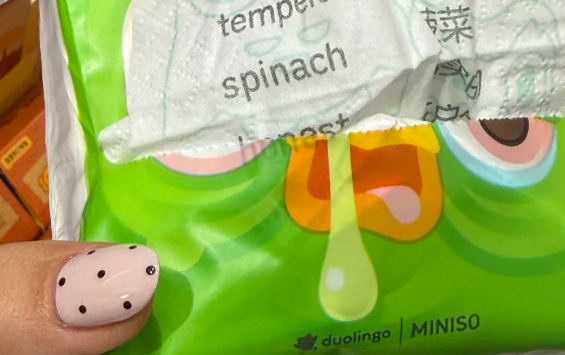
Duolingo's latest move: a co-branded tissue pack with MINISO that comes printed with English vocabulary words. Every sheet. Bite-sized phrases and words stare back at you — whether you're blotting lipstick, cleaning up a spill, or, as the brand seems to suggest, sitting on the toilet with time to kill.
The campaign follows Duolingo's earlier MINISO takeover, where the retail chain's stores were turned into language-learning pop-up spaces. But this one feels more targeted. More intimate. Possibly more ridiculous. The tissue packs turn a completely mundane moment — grabbing a napkin — into what the internet has gleefully dubbed a "随时随地大小卷" situation. Roughly: weaponized micro-learning with nowhere to hide.
The pairing also includes a toilet-themed blind box figure: Duo, the brand's mascot owl, perched on a toilet, phone in one hand, a roll of vocabulary tissue in the other. The scene is too real for anyone who has ever logged a Duolingo session from the bathroom. Which is apparently a lot of people.
This isn't the first time Duolingo has gone there. Back on April Fools' Day 2021, the brand unveiled "Duolingo Rolls" — custom toilet paper printed with bilingual example sentences — and staged the launch event inside a WeWork bathroom. It was a joke that turned into an actual product, eventually landing in 18 WeWork locations across China. The tissue packs, then, are less a wild pivot and more a patient, multi-year commitment to bathroom-based education.
The strategy fits neatly into Duolingo's broader persona in China: the "追杀式劝学" owl — what English-speaking fans know as the "unhinged reminder" owl — that will not stop hunting you down to finish your lesson. The tissue packs extend that energy into the physical world. There's no push notification, just a piece of paper asking if you know what "simultaneously" means.
The campaign has already generated the kind of social buzz that makes a brand manager exhale. On Xiaohongshu, users are posting photos of their word-covered napkins, and the comment sections are a mix of genuine fascination and mock horror. "以前是怕上厕所没纸,现在是怕纸上有单词" — one user joked that the old fear was running out of toilet paper, and the new fear is the toilet paper quizzing you. The layers of wordplay — 卷 meaning both "to roll/toilet roll" and "to compete fiercely" — are doing a lot of heavy lifting, and the internet appreciates it.
Behind the meme-ready packaging, the logic is sound: Duolingo knows its users steal learning minutes in the cracks of daily life. Why not own the bathroom break? At roughly the cost of a pack of tissues, the brand gets a physical object that sits on restaurant tables, in bags, on desks — each one a miniature billboard that says "we know exactly where you use our app."
Creepy or genius? The line has never been Duolingo's concern.