Buy two drinks, get a whole watermelon: Mixue stores launch a giveaway to help farmers
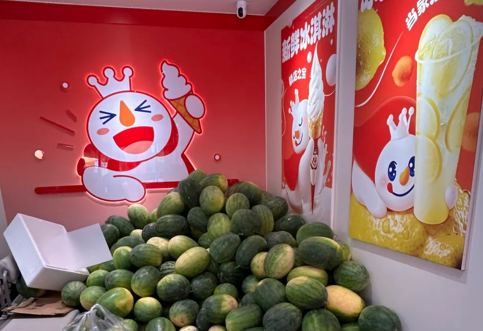
Mixue customers in parts of eastern China are walking out of stores with more than iced drinks. Some are carrying an entire watermelon.
Mixue customers in parts of eastern China are walking out of stores with more than iced drinks. Some are carrying an entire watermelon.
Beginning August 1, several Mixue locations in Nanjing and Lianyungang, Jiangsu province, launched promotions offering customers a free whole watermelon after purchasing two yellow-peach drinks. At some participating stores, any purchase was enough to qualify, with the exact rules determined by each location. Videos showing piles of watermelons stacked inside the brightly decorated stores quickly spread across Chinese social media and sent the unusual giveaway onto trending lists.
But the most important part of the story was not the size of the free gift. This was not a nationwide campaign designed by Mixue’s headquarters.
Several Mixue store managers in Nanjing reportedly organized the activity themselves after learning that watermelon growers in Kaifeng, Henan province, were struggling to sell their harvest. The managers pooled approximately RMB 16,000, made a nearly 1,200-kilometer round trip and purchased around 30 tons of watermelons directly from the production area. Mixue customer service later confirmed that the giveaway was a regional, store-led farmer-support initiative rather than an official national promotion.
Henan’s watermelon-growing regions have faced oversupply pressure this summer as large volumes of fruit reached the market at the same time. In some areas, farm-gate prices reportedly fell to only RMB 0.20 to RMB 0.30 per jin, equivalent to 500 grams. Watermelons with cosmetic imperfections were even harder to sell, leaving farmers at risk of watching part of their harvest spoil in the fields.
The Mixue managers turned their bulk purchase into a promotion that worked in several directions at once. Farmers received an immediate buyer for their produce, customers received a surprisingly generous summer gift, and participating stores attracted crowds without relying on discounts alone.
The response was immediate. One participating store reportedly gave away around 300 watermelons during the morning of August 1, while a location in Nanjing’s Pukou district distributed more than 500 in a single day. Staff said some customers placed orders even when they had not originally planned to buy a drink, simply because they learned that the watermelons had been purchased to support farmers.
The activity also spread beyond the whole-watermelon model. At Mixue’s flagship store in Hangzhou, customers were invited to sample chilled watermelon slices for free. Unlike the Nanjing promotion, visitors did not need to purchase two drinks—or buy anything at all. Staff served pre-cut cold watermelon in limited quantities on a first-come, first-served basis.
The different approaches show how individual stores can adapt the same basic idea to their location. Nanjing’s promotion used a whole watermelon as a high-impact reward tied to drink purchases, while the Hangzhou flagship treated the fruit as a free in-store summer experience. Both formats were easy to understand, highly visual and perfectly matched to the August heat.
For Mixue, one of China’s most recognizable affordable beverage chains, the story also demonstrates the potential of grassroots community operations within a large franchise network. National campaigns usually require extensive planning, standardized materials and coordinated execution. This initiative began with local store managers identifying a real agricultural problem and responding with their own money, transportation and store space.
That distinction helped the giveaway earn unusually warm reactions online. Consumers are accustomed to brands using charity language in carefully produced campaigns. Here, the action came first and the viral attention followed. The stores did not merely place an “aid farmers” slogan on a poster; they purchased 30 tons of produce and physically brought it back for customers.
There was still a clear commercial benefit. The promotion increased foot traffic, encouraged purchases of Mixue’s seasonal yellow-peach drinks and generated widespread organic exposure. But the marketing worked because the underlying action felt genuine. Customers knew where the watermelons came from, why they needed buyers and how their drink orders were connected to the effort.
It is a simple retail formula: solve a real problem, give customers something they genuinely enjoy and let the giant piles of watermelon handle the advertising.