Subway China and Rolife Launch DIY Miniature Store Campaign With Themed Venues in Shanghai and Beijing
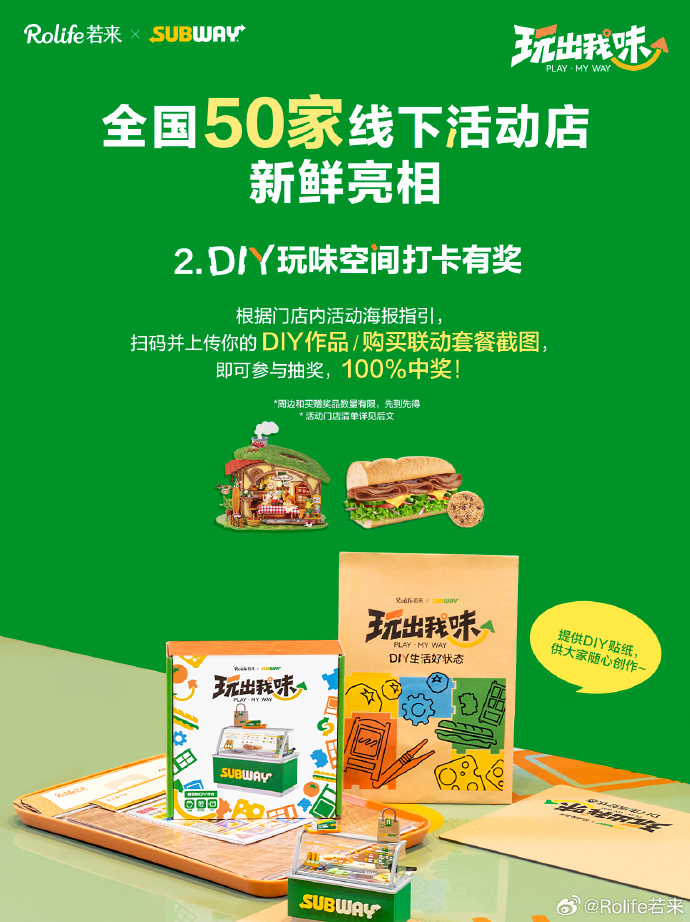
Subway China and Rolife launched a joint campaign on August 31, giving meal purchasers a DIY miniature Subway store kit and opening themed venues in Shanghai and Beijing.
Subway China (赛百味) and wooden puzzle brand Rolife (若来) launched a co-branded campaign on August 31, offering customers a DIY collectible model set when they purchase a designated collaboration meal at participating stores nationwide. The set includes a miniature Subway "cold counter" (迷你冷台) model kit, a co-branded paper bag with perforated cut lines, and a sticker sheet. Once the bag is cut and unfolded, it serves as a scene backdrop; the assembled counter is placed inside and decorated with stickers to form a miniature Subway shop.
Customers who purchase a Subway seasonal pass card (百味卡季卡) also receive the same model set directly. In a reverse traffic mechanic, shoppers spending 299 yuan or more at Rolife's own retail stores can claim a free Subway sandwich redemption voucher.
From September 5, the campaign expanded offline across two consecutive weekends with co-branded theme stores at Shanghai's Xujiahui Zhengda Joy City and Beijing's Jindi Center. Both venues feature miniature food-street installations designed for photo opportunities. A "DIY Creation Camp" (DIY创造营), open by reservation, lets visitors collect an assembly kit and craft freely using on-site materials and tools.
The collaboration brings together Subway's mass-market food-and-beverage footprint with Rolife's following among hobbyist model and puzzle collectors, using the physical product as a bridge between both brand communities. The dual-direction redemption mechanic — Subway meals unlocking Rolife collectibles, and Rolife purchases unlocking Subway sandwiches — channels foot traffic across two otherwise separate retail ecosystems, a structure increasingly common in China's experience-driven consumer marketing.