McDonald’s newest merch lets you carry fries on both shoulders
McDonald’s China has turned one of its most disposable objects—the brown takeaway bag—into one of its most sought-after pieces of merchandise.
McDonald’s China has turned one of its most disposable objects—the brown takeaway bag—into one of its most sought-after pieces of merchandise.
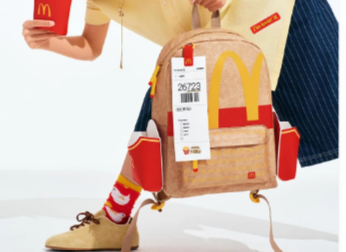
Created for the 12th edition of McDonald’s China’s annual Big Fries Day, the limited-edition “Big Fries Backpack” recreates the chain’s familiar paper packaging as a wearable bag, complete with two detachable French fry boxes positioned on either side. Released in three limited batches from July 23 to 25, all 5,700 backpacks sold out almost immediately.
The product was priced at RMB 119 plus 10 McDonald’s membership points and sold through the McDonald’s app and its McMall store inside WeChat. The daily allocation became progressively smaller: 3,500 units on July 23, 1,500 on July 24 and just 700 on the final day. The structure extended what could have been a one-time product drop into three consecutive moments of urgency, conversation and attempted checkout.
Visually, the backpack is built almost entirely from recognizable McDonald’s ordering rituals. Its lightweight DuPont paper material resembles the texture of a brown takeaway bag, while the front carries the golden arches, French fry graphics and a removable charm shaped like an order receipt. The side pockets resemble McDonald’s fry cartons and can be attached or removed with Velcro, inspiring jokes that owners could now carry fries on both shoulders.
Even smaller components continue the same visual language. The zipper pulls resemble fries dipped in ketchup, while the main compartment includes internal dividers and enough room for a 13- or 14-inch laptop. It is silly enough to become social content, but functional enough to exist beyond a photo—which is an important distinction in successful food-brand merchandise.
The backpack’s strongest marketing feature, however, is not printed on the bag. It is the story of how the product was created.
The original concept came from Daomeidan, a loyal McDonald’s customer and craft creator who had posted handmade bags inspired by McDonald’s takeaway packaging on Chinese social media. The creator had also attended two editions of the brand’s fan convention and shared other McDonald’s-themed handmade items with the community. Rather than simply reposting the work or treating it as free fan-generated publicity, McDonald’s invited Daomeidan to participate in developing the idea into an official product.
That decision turns the backpack into more than licensed merchandise. It gives the product a community origin story: a fan made something because they genuinely liked the brand, other fans responded to it, and the company demonstrated that it was paying attention.
For brands with large online communities, “listening to fans” is often reduced to replying under popular comments or asking followers to vote between predetermined options. McDonald’s took the more valuable route by moving an idea from the community into production. The result rewards one creator, validates the wider fan base and encourages more people to keep making and sharing brand-related content. A fan now knows that a sketch, joke or handmade object might not disappear into the feed—it could eventually appear in the official store.
This is community operation functioning as product development. Fans are not treated only as the final audience for a campaign; they become an informal creative network that can surface ideas already proven to resonate within the community. The company still handles design refinement, manufacturing, pricing, distribution and quality control, but the emotional insight comes from someone who understands the brand as a customer.
The limited quantity further strengthened that emotional value. Producing only 5,700 units kept the project closer to a collectible fan drop than mass-market school-bag inventory. The immediate sellout generated another round of social proof: people posted successful orders, complained that they had missed the release and circulated images of the unusual design. In this model, the merchandise does not need to generate significant direct revenue relative to McDonald’s restaurant business. Its real job is to create attention, participation and proof of fandom.
Big Fries Day provides the ideal platform for this strategy. McDonald’s China has held the event around the traditional Chinese solar term Dashu, or Major Heat, since 2015. The campaign is built on a Mandarin wordplay between Dashu and dashu, the shorthand commonly used for large fries. Over 12 editions, McDonald’s has developed the pun into an annual summer ritual combining menu promotions, limited merchandise and in-store experiences.
The backpack was therefore not an isolated novelty. It sat inside a wider 2026 campaign marking the 23rd anniversary of the “i’m lovin’ it” slogan in China and extending the brand’s ongoing focus on French fries. McDonald’s also introduced limited menu products, including a double-beef burger with thick mashed potato, bacon and meat sauce, alongside Italian spicy tomato-flavored seasoned fries. Six pieces of “crispy fries” themed merchandise were rolled out, selected restaurants received “i’m lovin’ it” themed spaces, and the classic soft-serve cone temporarily returned to a RMB 2 price point.
Its major offline activation was “Potato, Fries, Cloth,” a potato-themed remake of rock-paper-scissors. From July 22 to 25, McDonald’s distributed one million digital participation coupons through its app. On July 25, customers could visit participating restaurants between 2 p.m. and 5 p.m. and play against an employee. Winners received a free large fries, while losing still earned a free mini fries.
The game might appear simple, but it completed the campaign’s participation loop. The backpack generated scarcity and online discussion; the coupons moved users into McDonald’s digital ecosystem; the game brought them into restaurants; and the guaranteed reward ensured that even losing ended with the product at the center of the campaign: fries.
Together, these elements show why effective merch marketing is rarely just about printing a logo on an object. The best products translate a brand’s everyday behaviors into something fans immediately understand. The receipt charm, takeaway-bag texture, fry-carton pockets and ketchup zipper pulls work because they are based on details customers have already touched hundreds of times.
McDonald’s did not have to invent a new visual world for the backpack. It simply recognized that its existing packaging, ordering process and fan rituals already function as cultural assets.
More importantly, it recognized that one of its fans had already found the product hiding inside them.