LOEWE Made a Pair of Sandals Out of Fuse Beads — and It Works
LOEWE's latest campaign doesn't feature a runway, a celebrity face, or even a glossy studio shoot.
LOEWE's latest campaign doesn't feature a runway, a celebrity face, or even a glossy studio shoot. It features a pair of sandals made out of fuse beads — the kind you might remember from childhood craft tables.
For its 2026 Pre-Fall Type Fussbett sandal launch, the Spanish luxury house tapped Chinese creator
@雨析He
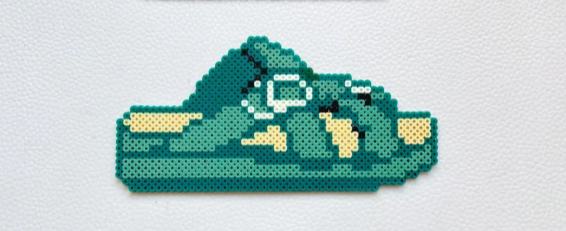
(Yu Xi He) to recreate the shoe bead by bead, documenting the entire process from pixel-like arrangement to hot-iron fusing and eventual 3D assembly. The result is a near-perfect replica: the crisscross leather straps rendered in beige beads, the chunky sole in darker tones, even the metal "LOEWE" lettering recreated with silver beads. Different colors represent the material contrast between leather, metal, and rubber — all in gloriously chunky resolution.
If you've spent any time on Chinese social media recently, you've seen
拼豆 (pīndòu)
— literally "pieced-together beans," the Chinese term for fuse beads or perler beads. The craft has exploded among young Chinese consumers over the past year or two, evolving from flat fridge magnets and keychains into intricate 3D sculptures, figurines, and now, apparently, high-fashion footwear.
LOEWE didn't just slap a logo on a bead kit and call it a day. The campaign video is shot like a careful making-of documentary — hands placing beads with tweezers, the satisfying press of an iron, the final shoe turning on a plinth like sculpture. It takes the visual language of DIY content that already thrives on Xiaohongshu (RED) and Douyin, and gives it the LOEWE treatment: considered, tactile, faintly obsessive.
This is the same brand that has, over the years, built an identity around craft — leather marquetry, ceramic collaborations, the annual LOEWE Foundation Craft Prize. Fuse beads are a logical, if wildly unexpected, extension of that DNA. The pixelated aesthetic even nods to the house's ongoing flirtation with 8-bit and digital nostalgia (remember the Minecraft collab?). The difference here is the cultural specificity: pindou isn't a global nostalgia play; it's a distinctly Chinese grassroots craft moment, one that feels closer to a local stationery-store hobby than a gallery wall.
There's also something quietly smart about how the campaign operates. Instead of producing a mass-market co-branded product, LOEWE commissioned a single creator to produce a single handmade object and turned that act of making into the content itself. It borrows the warmth and accessibility of pindou without turning the brand into a toy company. The Type Fussbett sandal — an actual leather shoe that presumably costs what you'd expect from LOEWE — remains the product. The bead version is a tribute, not a product drop.
Whether this drives sandal sales is almost beside the point. What it does is place LOEWE inside a visual and cultural conversation that luxury brands usually watch from a distance. It says: we see what you're making on Xiaohongshu, and we think it's worth our time.