Fenbid Turns Shanghai and Beijing Metro Stations Into Pain-Relief Art Galleries
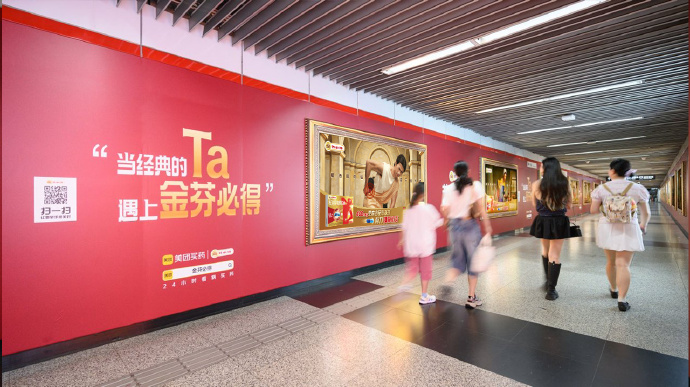
Fenbid has reimagined five Western masterpieces as pain scenarios across metro stations in Shanghai and Beijing to advertise its analgesic range.
Chinese analgesic brand 芬必得 (Fenbid) launched an out-of-home campaign on 24 August 2026 at two of China's busiest metro stations — People's Square in Shanghai and Guomao in Beijing — converting the transit corridors into gallery-style installations featuring five Western masterworks: the Mona Lisa, Girl with a Pearl Earring, the Discobolus, The Milkmaid, and The Thinker.
Each painting has been reimagined as a pain scenario: the Mona Lisa cradles her jaw to suggest toothache; the girl with the pearl earring cannot turn her stiff neck, a nod to frozen shoulder. The installations are rendered in lightbox format with gold-leaf-style frames set against red feature walls, giving the metro passages the feel of a museum corridor. Live models also performed the contrast between the figures' composed, "elegant" original poses and their pained, re-enacted counterparts, reinforcing the brand's analgesic message through visual juxtaposition.
The campaign uses no digital or social channel as its primary medium; the metro placements are the activation itself, placed in high-footfall nodes in both cities simultaneously.
The execution belongs to a recognisable pattern in Chinese consumer-goods marketing, where brands borrow the cultural gravity of fine art — its associations with prestige and timelessness — then subvert the imagery just enough to make a functional product claim land with humour. The contrast between classical dignity and everyday physical suffering does the persuasive work without a single line of clinical copy.