ByteDance turned a missing sock into a 3.5-minute noir thriller — no cameras, no actors
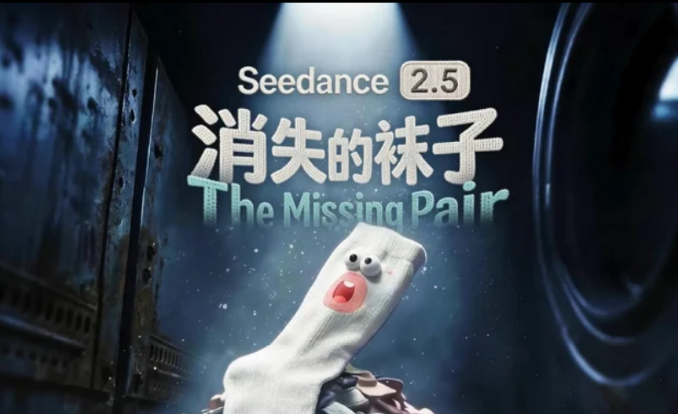
A sock disappears into a washing machine.
A sock disappears into a washing machine. Instead of a shrug, ByteDance turned that universal household mystery into a 3-minute-30-second Hollywood-style thriller.
The short film, titled
The Missing Sock
(《消失的袜子》), launched in early August to mark the release of Seedance 2.5, ByteDance's video generation model. The eye-catching part isn't the premise — it's that the entire film has zero human actors and zero live-action shots. Every frame was generated by the model.
Stylistically, it leans hard into film noir: moody lighting, subtle micro-expressions on characters' faces, and fabric that folds and drapes naturally. It opens in an advertising agency pitch meeting, where a team is brainstorming the selling points of an "anti-sock-swallowing" washing machine. Then the narrative dives into the protagonist's imagined paranoia — a sock tumbling into the mechanical "otherworld" inside the machine.
That structure is deliberate. The "play within a play" lets ByteDance test — and show off — its model across radically different scenes, from a realistic conference room to a surreal, machine-heavy fantasy space, all within one continuous story.
So what's actually new in Seedance 2.5? The film is a pointed demo of three technical pain points. First, multi-character scenes hold up without the "character drift" that plagues most AI video. Second, a clothes-tossing shot shows realistic fabric physics — the way cloth stretches and falls under gravity. Third, the washing machine teardown sequence was rendered from bare white-block wireframes alone, producing convincing metal and glass textures. The model also now supports single generations up to 30 seconds, which gives complex camera moves and coherent storytelling room to breathe.
The strategy is notable on its own terms. Rather than listing parameters, ByteDance keeps proving its model's growth through concrete, watchable narratives. Last Spring Festival, director Jia Zhangke used Seedance 2.0 to make a short where two "Jia Zhangkes" held a conversation across time — an early glimpse of the tech.
The Missing Sock
continues the same playbook: show, don't spec-sheet.
The bigger bet embedded in all this is that AI video will eventually carry real commercial weight in physical industries. A sock in a washing machine is a small, absurd stage for that argument to play out on — which might be exactly the point.