A mall in China turned last-minute summer homework into a full-on “competition”
A mall in China turned last-minute summer homework into a full-on “competition” For shopping malls, the old formula was simple: run a sale, offer some coupons,
A mall in China turned last-minute summer homework into a full-on “competition”
For shopping malls, the old formula was simple: run a sale, offer some coupons, put up a giant “50% OFF” sign and hope people show up.
But in China, malls are getting increasingly creative about giving people a reason to visit — and Zhong Yuan Jin Yi Shopping Mall in Zhengzhou may have just found one of the funniest examples yet: unfinished summer homework.
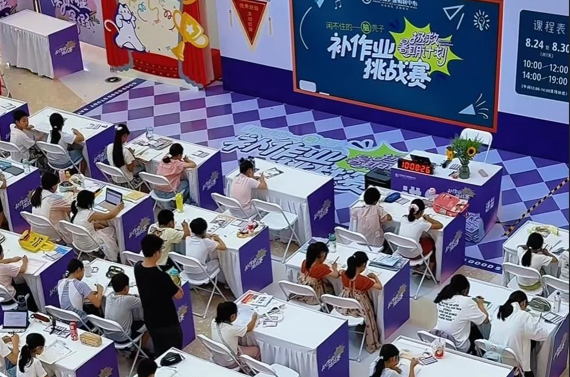
From August 24 to 30, the mall turned part of its first-floor atrium into a free “Save the Summer Vacation: Homework Challenge” for primary and middle school students. Despite the internet nickname “homework competition,” there are no winners based on grades or speed. It is essentially a giant communal study room dropped into the middle of a shopping mall.
Students bring their own homework and stationery, sit down and start working. The study area can accommodate 126 students at a time, and demand became strong enough that children were reportedly lining up before sessions began. One parent said the atmosphere made her child significantly more productive than studying at home.
And because apparently homework needed a loyalty program, the mall gamified the whole thing.
Every hour of focused study earns one stamp, with a maximum of five per day. Three stamps get a snack, five can be exchanged for a Mixue drink, eight unlock a trip to a local amusement venue, and 12 can get a movie ticket. An “NPC teacher” with a teaching qualification keeps order, while students also get scheduled breaks.
The result is a campaign that works because it barely feels like marketing.
Instead of telling families to come to the mall because something is cheaper, Zhong Yuan Jin Yi Shopping Mall identified an extremely specific end-of-August problem: parents have children with unfinished homework, children suddenly realize school is coming back, and everybody is stressed.
Then the mall turned itself into the solution.
Parents can leave their kids in a structured study environment while spending time elsewhere in the shopping center. Students get peer pressure in its most productive form — everyone around them is writing, so suddenly writing homework feels normal. The mall gets foot traffic, longer dwell time and, most importantly, a story people actually want to share.
That last part matters.
Discounts can generate sales, but they rarely generate conversation. “A mall is offering 20% off” is not something most people send to a friend. “A mall has opened a giant emergency homework room for kids who procrastinated all summer” practically writes the social media post by itself.
The smartest mall campaigns in China increasingly understand this distinction. Physical retail is no longer competing only on what you can buy inside the building. Almost anything can be ordered from a phone. What malls can offer much more effectively is a place to do something: watch something, participate in something, photograph something or become part of a temporary community.
That is why Chinese malls have been experimenting with everything from quirky competitions and themed markets to pet events, sports experiences and deliberately absurd public activities. In Yuncheng, for example, malls promoted more than 20 themed experiences over the May Day holiday, including a temporary urban “beach,” pet events, markets and sports challenges — explicitly packaging the mall as a leisure and social destination rather than simply a collection of stores.
The Zhengzhou homework challenge takes that logic one step further because the activity is built around a real-life pain point rather than entertainment alone.
There is also very little friction: participation is free, the concept can be understood in five seconds, and the timing is perfect. Every Chinese family with a school-age child knows the annual late-August homework panic. The campaign simply took that familiar ritual and made it public.
Some online commenters have understandably questioned whether children are being used to bring parents into the mall. But commercially, that tension is also what makes the idea interesting. The mall is not requiring parents to buy something before their children can participate. It provides something genuinely useful first, then benefits from the attention and foot traffic surrounding it.
That is a very different proposition from “spend RMB 500 and receive a gift.”
And perhaps that is the bigger lesson for retail marketing right now: when every mall can offer another coupon, the scarce resource is no longer discounts. It is attention.
People need a reason to stop scrolling, leave home and physically go somewhere.
Sometimes that reason is a spectacular exhibition.
Sometimes it is a concert.
And apparently, sometimes it is realizing on August 28 that your math workbook is still only half finished.
See the original on Instagram → @chinainsider